The cold open of The Takers is the film at its most assured. Before the title card appears, the film places us inside the logic of its world through action rather than explanation. The takers arrive. Someone is taken. Someone is killed. The rule of this world is established in two gestures: either you lose your freedom, or you lose your life. It is a clean and arresting opening, backed by sound design that does more atmospheric work than most of the dialogue that follows. The problem The Takers never fully overcomes is that the film does not sustain the authority of its own beginning.
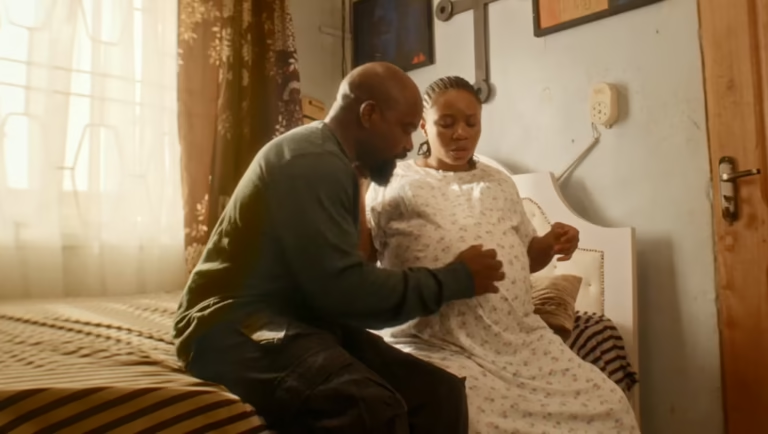
Directed and co-written by Toka McBaror, a filmmaker from Kaduna with a documented visual track record across over two decades of Nigerian filmmaking, The Takers is set in a world where a group of people terrorise surrounding communities through slave raiding. At the story’s centre is a woman taken along with her lover by the sheikh who leads these raids, and the man known as Master Rufus, who employs the labourers of a nearby community and whose household becomes the site of an alternate social world as the captives’ fate unfolds elsewhere.
The Takers
Directed by: Toka McBaror
Produced by: Toka McBaror, Chloe Coko
Genre: Drama
Released on: August, 2026 (Prime Video)
Language: English
Tyranny and What It Asks of the People Under It
The film’s most coherent emotional argument is embedded in its opening device. The takers are defined not by complexity but by function: they take. What the story then tries to do is build a world around those who have been taken or fear being taken, exploring what that sustained threat does to people’s choices, relationships, and sense of possibility.
There are genuine ideas in this premise. The way fear of a group can poison how communities receive even innocent individuals from that group is something the film touches on when northerners arrive at Rufus’s compound and are met with suspicion. The film also gestures at the economic dimensions of the slave trade, the way labour extraction and human trafficking occupied a shared moral universe in which ordinary people made transactions that their circumstances had made thinkable.
What the The Takers does not do is develop these ideas into a story with sufficient emotional architecture. The central female protagonist’s arc is the narrative spine the film needs. But the decisions around her are not built carefully enough for her final act to land with the force it requires. We understand what happens to her. We do not feel it in the way the film needs us to. This goes the same way for other characters and the film in general.
A World That Collapses Between Its Events
The film runs seventy-nine minutes, a length that should work in the favour of a story this focused. It does not. The pacing problem is not one of duration but of rhythm. Scenes that have made their point continue past the point of making it. Dialogue is delivered at a tempo that suggests the film is uncertain of its own material and is therefore giving the audience additional time to receive what has already been communicated. Actions that should be completed in one scene bleed into the next. The cumulative effect is a film that feels considerably longer than its runtime while also leaving significant narrative gaps unexplained.
Some subplots are introduced and some are completely unnecessay. The film raises questions it does not answer, and these are not the productive ambiguities of confident storytelling but the unintended gaps of a screenplay that lost track of what it started. A character whose access to crucial information drives the story toward its resolution is never given a credible reason for possessing that information. He is convenient rather than earned, and the plot’s dependence on him becomes a liability precisely at the moment the film needs to feel most assured.
There is also a late revelation, arriving close to the film’s conclusion, that appears designed to add dramatic weight but is introduced and then immediately abandoned without the thematic development that would justify its inclusion. A story beat that arrives without consequence is not a twist but a detour. It seems deployed for shock value rather than thematic substance. A revelation that does nothing to deepen our understanding of the characters or the story’s argument is simply plot machinery wearing the costume of meaning.
Performances That Cannot Carry What the Script Will Not Build
The performances share the film’s general problem of deliberateness without purpose. Delivery is slow where it should be careful, which are different things. Careful delivery communicates interiority and weight. Slow delivery communicates that the scene is not entirely certain of itself. The result is an ensemble that functions more as visual presence than as lived characterisation. This is not necessarily the fault of the individual actors, who are working within a film that has not given the performances the material they would need to be striking. When everything the cast says is delivered at the same measured pace, the texture of human difference between characters begins to flatten.
The note is general because the film does not give sufficient individual distinction to its characters for individual performance notes to be entirely fair. What can be said is that the opening sequence, which requires almost no dialogue and operates on physical action and reaction, is the most convincing performance of the film’s running time. When the script retreats and the visual language takes over, the film finds its most natural register.
The Eye That Works and the Costumes That Don’t
Toka McBaror’s visual instincts are the film’s most defensible quality. His cinematography has been recognised at the award level across multiple projects, and the craft is visible in The Takers even where the story fails to use it well. The film’s understanding of space, light, and atmosphere is genuine. The AMAA nominations the film received were for Best Production Design, Best Makeup, and Best Visual Effects, and the visual ambition behind those nominations is evident.
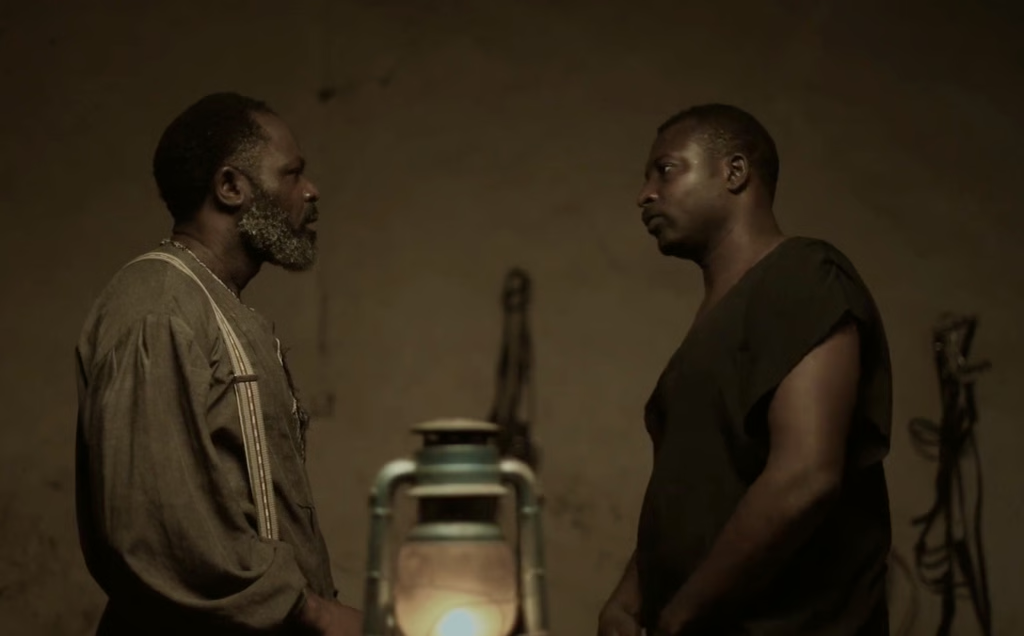
The costume question, however, is the film’s most significant cultural misstep. The aesthetic language of the enslaved characters references American antebellum plantation imagery: the dungaree-style trousers with suspender straps, the particular vocabulary of visual poverty that Hollywood’s slave narratives have established as the visual code for captivity. This is not what the northern Nigerian slave trade, or the broader West African experience of enslavement, looked like.
The Trans-Saharan slave trade that operated through what is now northern Nigeria had its own material culture, its own visual reality. Hausa-Fulani traditional dress of that era was robes, embroidered kaftans, wrapped cloth: a visual language entirely different from the one borrowed here. For a film trying to tell a specific Nigerian story of human trafficking and captivity, dressing its subjects in the visual language of a different continent’s history of slavery is a failure of cultural research. It distances the film from the very authenticity it is reaching for.
Final Thoughts
The historical subject matter this The Takers approaches has genuine weight however. Northern Nigeria’s history of slave raiding is a part of the country’s past that has insufficiently, or not, been examined in its cinema. A film that committed fully to that history, in its visual language, its structural discipline, and its character work, would be a significant contribution. The Takers has the opening of such a film and the intentions of such a film.
Verdict
Watch this if you find value in seeing how Nigerian cinema approaches the slave trade as historical subject matter. The opening sequence is worth the first five minutes. What follows might test your patience considerably more than that. The visual ambition of The Takers deserves a better story than it was given.
Rating: 1.5/5