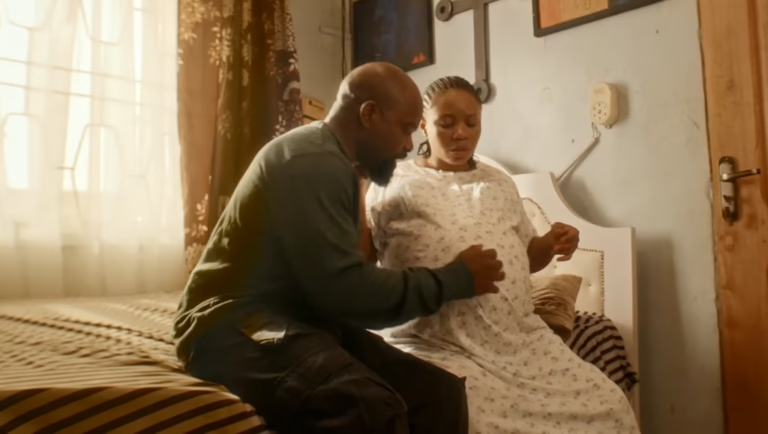
Before Black Market entered a single cinema, it had already made history. On the 26th of September 2026, 51,000 people gathered at Tafawa Balewa Square in Lagos and watched the film together, breaking the Guinness World Record for the largest attendance at a film screening. What is less official, and considerably more interesting, is the economics of how it got there. Tickets were sold at ₦2,000 each, described in promotional material as less than twenty percent of a standard cinema ticket today. The film Black Market, about the underground economy, was marketed at ‘black market’ prices. At 51,000 qualifying viewers, that is north of ₦100 million collected in a single night.
Black Market follows a group of women running a well-organised cross-border smuggling operation dealing in foodstuff, predominantly foreign rice, in the middle of Nigeria’s economic chaos. Their rivals, led by Junior, operate in fuel smuggling and keep hitting walls: checkpoints catch their consignments, their routes are blocked, and the question eating at Junior is how the women move so freely when his operation cannot.The women refuse. The men force the issue. The film is built on that conflict, and the idea inside it is genuinely worth making.
Black Market
Directed by: Fatimah Binta Gimsay
Producer by: Nora Awolowo
Genre: Thriller
Released on: October 2, 2026 (Cinemas)
Language: English
A Rivalry That Needed Its Roots
The most important thing Black Market could have done was make the audience understand why Zimuzo, the leader of the women’s operation, will not work with Junior. The history between them is not vague. The film dramatises it. But dramatising something and making it felt are two different things, and here they remain at a frustrating distance from each other. When Zimuzo refuses the men’s proposal, the decision should carry the weight of everything that happened between her and Junior. The scene should arrive like the surface expression of something deep and unresolved. Instead, the refusal reads as the logical response of someone who simply does not want to collaborate. The past is present but not alive in the scene, and the difference is the distance between a crime drama with genuine emotional stakes and one whose conflict operates primarily at the level of plot mechanics.
That gap matters most because everything that follows depends on the audience believing in the specific cost of what Zimuzo is protecting and what she risks. When a rival threatens the women’s operation by kidnapping Adesua’s daughter, the stakes should escalate into something personal. The film intends this. The execution does not sustain it. We understand that the daughter’s life is in danger. We understand that the women must make a dangerous move. What we cannot fully feel is the weight of that decision at the particular moment when it arrives.
A World Built on Thin Ice
For a film about rival criminal empires, Black Market has a problem selling the scale of either one. Junior is presented as a figure whose reach extends across operations and whose authority commands fear. But the visible machinery of his power is too small to communicate that authority. A criminal operation that appears to run on a handful of couriers cannot project the threat that the story assigns to its leader. The film never explains this away, and the result is that Junior’s menace arrives through dialogue more than through the evidence of his world.
The women’s operation has its own version of this problem. The police insider who helps their consignments through checkpoints is a narrative convenience that the script deploys without fully earning. The structural advantage it gives the women over the men is the most visible explanation for why the women succeed where the men fail, but the relationship is never given the texture or risk that would make it feel like something more than a device. A contact who moves freely between the women’s criminal world and an institutional one is potentially the film’s most dangerous and interesting character. He is not treated as such.
Several characters within the ensemble exist primarily to enable plot movement rather than to occupy the story in their own right. Their presence generates events without generating meaning, and the arcs that should build between characters never accumulate the weight needed to make the film’s emotional beats land with force. The ending, when it arrives, confirms this deficit. It closes a sequence of events without closing the emotional argument those events were supposed to make.
The Ensemble That Carries Its Own Weight
The performances are where Black Market does its most reliable work. Linda Ejiofor-Suleiman, who made history at the 2026 AMVCA by becoming the first actress to win both Best Lead Actress and Best Supporting Actress in the same night, brings to her role the grounded specificity that distinguishes her best work. She gives her character the quality of someone whose decisions are rooted in a clear internal logic, which is more than the screenplay always provides. Where the writing offers her little structural support, she builds her own.
Omowunmi Dada and Scarlet Gomez both hold their scenes with the kind of presence that communicates character even when the dialogue does not. The ensemble as a whole performs with a collective credibility that the film’s world-building does not always match. These feel like people who have found a way to inhabit their roles rather than simply execute them, and that is a meaningful achievement in a film whose writing does not always make such achievement easy.
Ambition Visible, Control Still Developing
Fatimah Binta Gimsay‘s direction is functional throughout. The film moves with enough efficiency that it never loses its audience entirely, and there are passages where the visual and editorial instincts serve the story well. The art direction establishes mood and communicates setting with enough specificity that we always understand the kind of spaces these characters move through. The cinematography does useful work in moments where character motivation is unclear, providing visual coherence that the scene’s writing sometimes lacks. Sound design keeps the film balanced in its more chaotic sequences.
What Gimsay does not yet fully command is the control that turns a well-constructed crime drama into an emotionally convincing one. The world she built has the shape of something dangerous without consistently generating the feeling of danger. Her instinct for atmosphere is visible. Her instinct for when to push against the scene’s emotional grain, and when to simply let it sit, is still developing. Finishing a debut feature at this scale is an achievement that deserves acknowledgement.
Final Thoughts
The record at Tafawa Balewa Square is worth celebrating on its own terms. Fifty-one thousand people in one place for one Nigerian film is a statement about appetite, about what audiences will show up for when the invitation is compelling enough. Black Market invited them to be part of something larger than a screening, and they came. That the film did not fully match the scale of the event is not a reason to diminish either.
What Black Market reveals about the current state of Nollywood crime drama is something more specific: the genre has found its audience but has not consistently found its craft. The premise is here. The ensemble is here. The cultural subject matter is here. The ability to build a world convincing enough to contain them, and to tell a story that earns its own emotional destinations, is what the next version of this film needs to be.
Verdict
Black Market is a film that earns its audience’s attention more reliably than it earns its ending.
Rating: 2.75/5