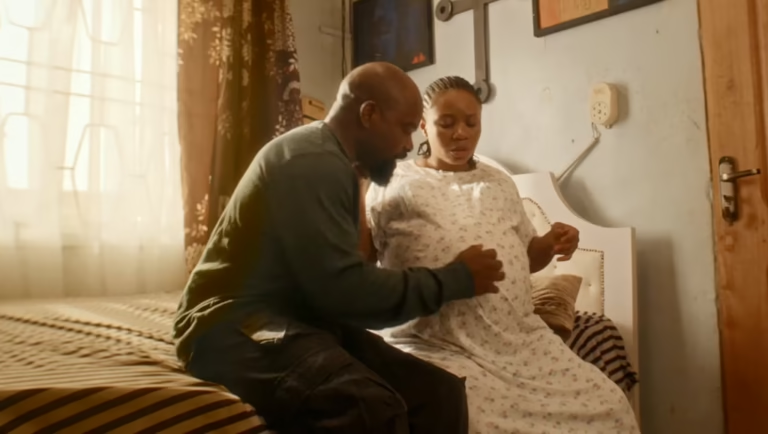
Before Dear Ajayi arrives in Nigerian cinemas it became the first Nigerian film selected for Venice Days, the Giornate degli Autori strand of the Venice Film Festival. It left with two prizes: the Premio Enrico Fulchignoni, presented by UNESCO, which praised it as a witness to the creative moment Nigerian cinema is currently in, and the Premio Bisato d’Oro for Best Cast and Performances.
Written and directed by Damilola Orimogunje, his second feature after For Maria Ebun Pataki in 2020, and produced through a Nigeria-Germany co-production between 2o9ine Films and Mayana Films among others, the film is set in Ibadan in the late 1990s, when Nigeria is suspended between decades of military dictatorship and the approaching possibility of civilian rule. Two estranged sisters, Ade and Titi, are forced back under the same roof to care for their ailing mother. Everything that follows is an examination of the different shapes that a restricted life can take.
Dear Ajayi
Directed by: Damilola Orimogunje
Written by: Damilola Orimogunje
Genre: Drama
Released on: September 18, 2026 (Cinemas)
Language: English
How Restriction Lives in the Body
Dear Ajayi’s most coherent and original organizing principle is restriction. It appears in different forms across nearly every character, and understanding it is the key to understanding what Orimogunje is doing here.
Ade, the nurse played by Bimbo Akintola, has built a life that society recognises as correct. She provides. She prays. She carries her sick mother, her two children, her painter husband Michael, and the household’s financial weight, simultaneously and without complaint. Her restriction is visible in her silences: the long pauses before she responds, the deliberate pace of her speech, the way she delivers a line as though she is measuring each word against everything she has chosen not to say. She is not an unexpressive woman. She is a woman who has learnt where expression is permitted and where it is not, and she lives precisely within those borders. Where she finds release, even briefly, is in her sister’s music. The film is careful about this. Ade’s most open moments are not hers alone; they happen in the presence of someone who has chosen a different kind of life.
Titi, played by Tosin Adeyemi, wears her freedom as costume and performance. She is heard before she is fully seen, singing to herself in the dead of night in a way her family cannot understand. Her restriction is not in her bearing but in the world surrounding it: a music industry that demands compromises she was not prepared to make, relationships that begin with promise and reveal themselves as another form of containment, a family that reads her ambition as irresponsibility. When she sings Nina Simone, she sings it with a completeness that the character brings to everything she does.
There is a particular performance, the longest and most extended in the film, in which the lyric she delivers sits over the whole of her character like a question that has not yet been answered. “Why do you want to fly, blackbird?”, it says, “You ain’t gonna fly”.
Michael, Ade’s husband, played by William Benson, carries the restriction of a man whose dreams have produced no economic validation. His paintings sell cheap and generate guilt rather than pride. His restriction expresses itself differently from the women’s: it accumulates internally, slowly visibly changing his posture and his relationship to the people around him. The film handles his evolution with the same restraint it applies to everything, and what William Benson communicates in his quieter moments lands with greater precision than any declaration of frustration could.
The nation outside is also restricted. Radio reports of economic reform and the possibility of civilian governance run in the background, not as political commentary but as atmospheric context. A country trying to transition from one system to another while the people living in it are trying to figure out what transition means for them personally. The parallel is not stated. It does not need to be.
A Film That Takes Its Time and Knows It
The pacing of Dear Ajayi might test the patience of audience accustomed to clearer narrative mechanics. The film does not move toward a destination in the way that most narratives do. It moves forward the way lives move forward: not through escalating plot points but through the accumulation of small moments whose significance may not be clear until later. For some audiences, this produces genuine engagement. For others, it produces the unsettled feeling of not knowing where the story is going or whether it will eventually arrive.
That tension is not entirely unintentional, and it is worth sitting with rather than dismissing as a flaw. But there are places where the pacing crosses from deliberate into indulgent, and where a more decisive editorial hand would have served the film’s emotional argument better. The timeline also becomes occasionally unclear in ways that feel less like formal ambiguity and more like structural imprecision. When the passage of time matters to a story, as it does here, the film has an obligation to anchor its audience in that time clearly enough that they feel it moving rather than simply being told it has.
The Lagos sequences, which briefly follow Michael into a larger city in search of a better market for his work, provide tonal contrast and are among the film’s more energetically constructed passages. But they exist in a slightly different register from the Ibadan scenes, and re-entry into the main story’s quieter rhythm requires a moment of adjustment.
Discipline in Front of and Behind the Camera
The ensemble quality of the performances in Dear Ajayi is among its most significant achievements. The performances exist in relation to each other. Bimbo Akintola’s silences mean what they mean because of who she is silent in front of. Tosin Adeyemi’s expressiveness registers as both freedom and restriction because we have spent time watching Ade’s containment. The performers have been directed to serve the film’s central argument rather than their own moments, and the result is an ensemble that coheres in the way that good chamber drama coheres.
The film’s directorial discipline extends to how it handles its recognisable faces. The camera does not linger on a star simply because a star is present. In a scene featuring Kalu Ikeagwu as Michael’s friend, the framing deliberately delays showing his face because in that moment the scene belongs to Michael, not to his visitor. When Uzoamaka Power appears as Lizzy, Titi’s friend, the film grants her exactly the space her character requires and no more. The temptation to let a face of that recognisability carry a scene is resisted entirely, which says a great deal about the coherence of Orimogunje’s vision.
The same discipline is visible in KC Obiajulu’s cinematography. The characters we follow are restricted people in a restricted world. The camera follows that restriction. It does not seek grandeur where the characters cannot access it. There are moments of genuine visual beauty in the way that light enters the domestic spaces, a quality of illumination that is carefully observed and specific to the world being depicted. But the cinematography does not pursue beauty at the expense of truth, and that restraint is appropriate rather than timid. The banjo that recurs on the score, playing irregularly, one note at a time, is doing something similar aurally. It is not decorative. It is the sound of restricted life.
Ré Olunuga’s score and the diegetic music around Titi’s performances work in concert throughout. The film handles its musical sequences with enough seriousness that they function as part of the dramatic argument rather than as interludes from it.
Final Thoughts
Dear Ajayi is a film that will mean considerably less to an audience that is not willing to give it the attention it demands, and considerably more to one that is. It is not designed for passive viewing. It asks you to sit alongside its characters rather than follow them, to feel the texture of their daily lives rather than trace the arc of their decisions. When that invitation is accepted, the film delivers something real: a portrait of women whose circumstances are shaped by forces larger than any individual choice, and whose dignity consists precisely in how they carry those circumstances without being entirely defined by them.
The UNESCO jury described it as a witness to the creative moment Nigerian cinema is currently in. What it witnesses, more specifically, is the possibility of a Nollywood that draws from the international tradition of social realist drama without losing the specific texture of its Nigerian setting. That is not a small achievement. It is the kind of achievement that tends to go unnoticed by domestic audiences and earn recognition abroad, which is both Dear Ajayi‘s current situation and, perhaps, part of what the film itself is about.
Verdict
Dear Ajayi rewards patience in the specific way that genuine art rewards attention. If you go to the cinema expecting a story to carry you along, this film will frustrate you, and honestly, it is worth knowing that before you go. If you go prepared to observe, to sit with characters whose lives are not structured for easy consumption, you will find something in this film that most of what plays alongside it does not offer. It is the kind of Nollywood film that needs to exist even if it will not be comfortable for the audience it most needs to find.
Rating: 3.5/5