The premise of One Gidi Night is one of Nollywood’s most cinematically precise in recent memory: a single night in Lagos, unfolding in real time, following a good man drawn into danger through circumstances not entirely of his own making. Written, directed, and produced by James Abinibi and distributed by FilmOne Entertainment, the film hit cinemas on the 11th of September 2026 with a cast built around Gabriel Afolayan, Uzor Arukwe, Wumi Toriola, Idia Aisien, Kelvin Ikeduba, and Ibrahim Yekini.
One Gidi Night is a film with a clearly stated argument, competently constructed, and often well-performed. It is also a film that communicates its central idea to the head while consistently failing to deliver it to the body, which is where thrillers live or die.
One Gidi Night
Directed by: James Abinibi
Written by: James Abinibi
Genre: Thriller
Released on: September 11, 2026 (Cinemas)
Language: English
What the Night Is About
One Gidi Night announces its thematic interest in a single line that functions as the film’s compressed moral philosophy: “You hustle first and explain the rest to God later.” It is the kind of statement that captures something specific about how survival operates in a city like Lagos, where the calculus of necessity and conscience does not always resolve cleanly in favour of either, and where a decision made at two in the morning can look very different by daylight. The film is built around exactly that: the moment desperation overrides deliberation, and what follows when the consequences of a single night begin to compound.
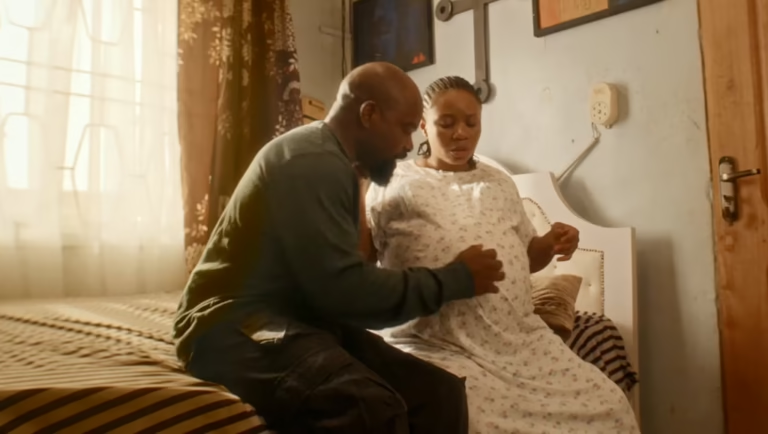
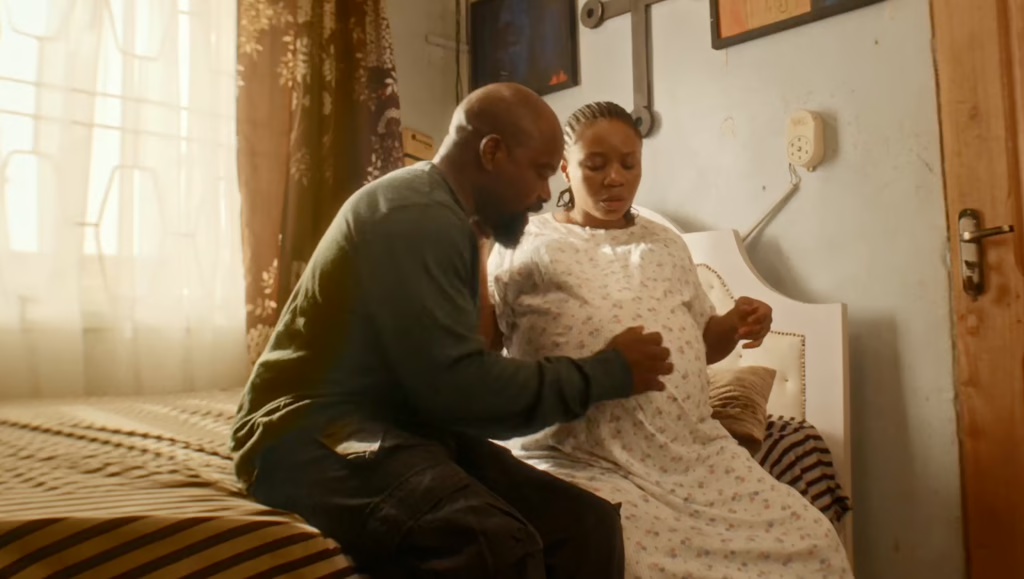
The story follows Ejiro, a dispatch rider doing legitimate work, whose night turns dangerous not through any choice he made but through the actions of people around him. What begins as a seemingly straightforward job conceals a reality he never agreed to, and by the time the night is fully underway, Ejiro is caught inside a situation whose true shape has been hidden from him. Simultaneously, his pregnant wife is on the verge of giving birth and needs him to reach her. He cannot get there. The film unfolds in the gap between where he needs to be and everything standing in the way.
That setup is genuinely interesting because it distributes the moral weight across multiple characters rather than placing it all on the person the film follows. Ejiro is neither innocent nor guilty in the conventional thriller sense: he is a man being acted upon by circumstances rather than driving them, and the revelations that gradually emerge about how he arrived in this situation add layers that give the story something more to say than a straightforward crime narrative would allow.
The difficulty is that the film reaches for emotional access to that question primarily through explanation rather than experience. One Gidi Night is consistently the kind of thriller that explains its logic clearly enough for you to follow the argument without making you feel the urgency that would make that argument land with full weight.
A Chain of Decisions That Doesn’t Always Hold
The real-time structure is one of the film’s most confident formal choices, and it creates a specific kind of pressure. When a story happens in real time, every decision’s consequences arrive before the audience has had time to adjust to the previous one. The tension should be cumulative, each beat feeding directly into the next, the audience unable to step back because the story refuses to let them. In its best passages, One Gidi Night achieves this. The movement through specific Lagos geography, from Sangotedo through Awoyaya to Lakowe, gives the night’s journey a texture of place that the city richly provides, and the film earns credit for tracking its characters through a Lagos that feels mapped rather than staged.
What undermines the structure is the credibility problem in the chain of decisions. By the time the film’s escalation has reached its midpoint, a question begins forming that the film’s explanations do not fully resolve: not “what is happening?” but “would this character actually do this in this moment?” The difference is important. A thriller that makes you ask the first question is building mystery. A thriller that makes you ask the second question is losing its grip on character logic.
The frustration that emerges from this is specific to how thrillers work. When you stop believing the next decision before it is made, you become an observer of events rather than a participant in them. The emotional engagement that a film like this needs, the kind that makes escalation feel like pressure rather than accumulation, requires the audience to be inside the character’s choices rather than watching from outside them. One Gidi Night, despite its craft, eventually leaves its audience on the wrong side of that threshold.
The flashbacks woven into the real-time narrative serve the structure’s expository needs without consistently deepening the emotional access to the characters they introduce. They explain context where the story needs them to deliver feeling.
Gabriel Afolayan and the Performance the Film Was Built For
James Abinibi has stated that he wrote One Gidi Night for Gabriel Afolayan; Afolayan’s was the only face he could see for Ejiro. That kind of directorial investment in a specific performer tends to produce a specific kind of screen presence, and it does here. Afolayan gives the film its most visceral emotional work, making Ejiro’s desperation specific and physical in ways that the film around him does not always match. He is the performance that keeps the film’s argument most alive even when the plotting is working against it.
Uzor Arukwe’s dual performance as twins is one of the film’s more demanding structural choices, and he meets it with enough internal differentiation that the two characters read as genuinely separate people rather than variations on the same man. The twin structure generates real narrative uncertainty in the moments it is designed to, which is the correct outcome for a thriller organised around concealed identity.
Wumi Toriola and Idia Aisien bring the textured supporting work that both are known for, though neither is given the space to develop into something the film specifically needs. The ensemble including Ibrahim Yekini, performs solidly throughout. The gap between the individual performance quality and the film’s emotional impact is not a performance problem. It is a character logic problem that the performances cannot solve independently.
Lagos as Atmosphere, Craft as Foundation
The production understands the Lagos it is filming. The city’s specific geography is not merely background but a character in the film’s logic, and the tracking of the night’s movement through named, recognisable locations gives the story a grounding in physical reality that the thriller structure needs. Lagos at night is a genuinely cinematic environment, and the film uses what the city offers with enough precision to suggest a crew that had thought carefully about where they were and why.
The cinematography and editing maintain the pace required by a real-time structure without sacrificing visual clarity for velocity. The transitions are smooth enough that the night’s progression feels continuous rather than assembled. These are genuine craft achievements and they deserve acknowledgement. The technical work is consistently above the level of the film’s emotional impact, which is part of what makes the gap between what the film achieves and what it reaches for so noticeable.
Final Thoughts
One Gidi Night is a film that knows what it wants to say and is not short of craft in saying it. The argument it makes, that desperation can recalibrate a person’s moral operating system in ways they deal with afterwards rather than before, is an honest and specific observation about how survival actually works in a city that puts that calculation to its residents regularly. The line “you hustle first and explain the rest to God later” is not a glorification. It is a diagnosis.
The film’s limitation is not that this argument is wrong or that the craft is insufficient to carry it. It is that a thriller’s argument has to be felt before it can be heard, and One Gidi Night inverts that order. It makes its case clearly while failing to make the audience feel the urgency that would make that case arrive with full weight. Understanding why a character does something and feeling the unavoidability of that choice are two different experiences, and only the second one produces the kind of engagement that a real-time thriller promises.
Verdict
One Gidi Night is worth viewing for the Gabriel Afolayan performance and for what the film reaches toward. It is more interesting as an intention than as an experience, which is perhaps the most honest thing that can be said about a thriller that is smarter than it is visceral. James Abinibi has the instincts for this kind of filmmaking. A tighter grip on character logic would give those instincts the dramatic fuel they need.
Rating: 2.9/5