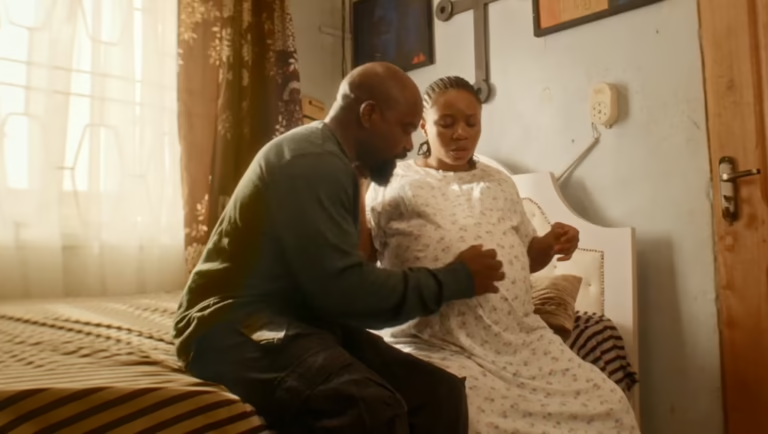
Family drama in Nollywood has a familiar architecture: buried truths, disrupted stability, the return of someone who was supposed to stay gone. A Father’s Secret, directed by Adeoluwa Owu from a screenplay by Moshood Yakubu Olawale, works within that architecture without being imprisoned by it. The film follows a woman whose life, rebuilt with effort over a decade of her father’s absence, is unsettled by his unexpected return.
It is not a premise that announces itself as urgent, and for a significant portion of its two-hour runtime, the film moves with the kind of deliberateness that asks the audience to trust that what is being built has somewhere to go. For much of that time, that trust is earned. The film’s final act is where the bill for that patience comes due, and the payment falls slightly short.
A Father’s Secret
Directed by: Adeoluwa Owu
Written by: Moshood Yakubu Olawale
Genre: Drama
Released on: August 21, 2026 (Cinemas)
Language: English
What A Father’s Secret Is Actually About
A Father’s Secret is, on its surface, about a father’s return. Beneath that, it is a film about what absence does to the people it leaves behind, and what the person who caused it owes on returning. There is a question the film keeps alive through its slower passages: when someone who caused significant damage eventually reappears, what does accountability actually look like, and is forgiveness a destination or a performance?
The film organises its emotional argument across the relationships that the father’s absence shaped. The woman at the centre of the story has built a life in the space that his absence created, and the arrival of characters tied to that earlier failure begins dismantling those arrangements in ways both expected and not. The screenplay understands that this kind of story lives in the texture of small revelations rather than a single dramatic confrontation, and it distributes those revelations with enough patience to maintain the audience’s investment.
The themes, neglect and the long shadow of parental failure, are present throughout and are generally legible without being overexplained. The film’s thematic clarity is one of its more consistent qualities.
A Slow Start
The plot takes its time. That is both a description and a fair criticism. At two hours, the film carries at least twenty minutes that could have been trimmed without losing any emotional or narrative substance. The prologue, which uses a church setting to open the story, is functional rather than compelling, and a stronger opening might have provided the film with more goodwill to spend during its more patient sequences.
That said, the film eventually settles into its rhythm. It is a slow burn, and viewers looking for immediate conflict may find the early stretches uneventful. The story gradually reveals where it is going, however, and some of the later developments make the patience easier to understand.
The bigger issue is the runtime. At roughly two hours, A Father’s Secret feels longer than it needs to be. There are stretches where the narrative could have moved more efficiently without losing the simplicity that appears to be central to its approach. A tighter runtime would likely have made the film feel more purposeful.
The plot twist, when it arrives, does what effective structural surprises should do: it recasts what the audience has already watched, prompting the kind of retrospective recalibration that good mystery plotting generates. The surprise itself appears to land for most viewers without having been obviously telegraphed.
Where the Film Finds Its Best Self
The casting is one of the film’s more interesting choices. Alongside recognisable names, it gives room to performers who may not yet be as familiar to audiences, and that helps the film retain a sense of freshness.
Princess Nkwocha, who plays young Ize, makes a strong impression. She brings an assuredness to the role that makes her scenes particularly engaging, and her performance is one of the easier elements of the film to remember.
The rest of the cast generally handles the material well, particularly in scenes where the drama depends on believable reactions rather than heightened performances.
The Technical Picture
A Father’s Secret does not appear interested in making its technical elements the main attraction, and that largely works for the kind of film it is. The cinematography is adequate for the story. The same can be said of the soundtrack, which supports the film without leaving a particularly strong impression.
The screenplay is similarly straightforward. It does not attempt to do too much, and that restraint can be both a strength and a limitation. The simplicity keeps the story accessible, but it also means there are fewer layers for the film to explore. The score by Tolu Obanro supports the film’s tonal range without overreaching.
Final Thoughts
A Father’s Secret is an uncomplicated family drama that takes a deliberately measured route to its story. Its strongest qualities are found in its performances, conversational dialogue and the moments where its characters are allowed to interact naturally.
Its biggest drawback is the amount of time it takes to get there. The film could have benefited from a sharper opening and a more economical runtime, particularly because its straightforward narrative does not require such an extended running time.
Still, there is something pleasant about its approach. It is the kind of film that can be watched without demanding too much from its audience, allowing the family dynamics and gradual revelations to carry the experience.
It may not be a particularly demanding watch, but sometimes that is exactly the point.
Verdict
A Father’s Secret is a relaxed family drama with solid acting and an accessible story. Its slow pace and extended runtime keep it from being as efficient as it could be, but the performances and natural dialogue give it enough warmth to remain an easy watch.
Rating: 2.55/5