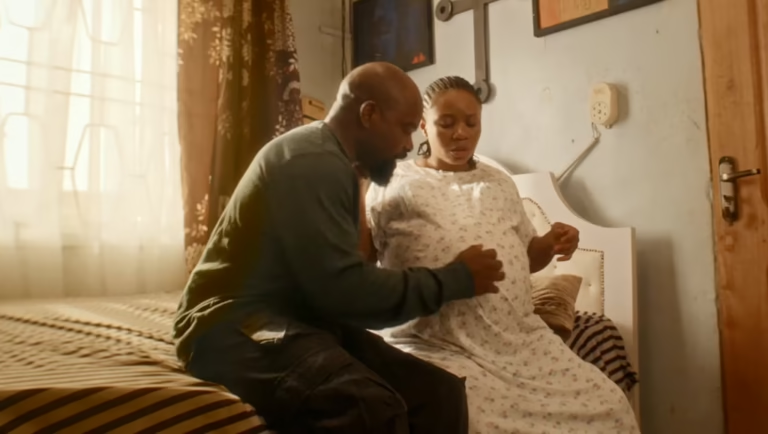
There is a film inside On Different Grounds that works. It is the one about two people who built a life together, watched it collapse under the weight of ambition and pride, and are now forced to occupy the same space again after years of silence. It is the film about what happens when a woman realises that the empire she helped architect exists entirely without her name on it, and about the man who cannot quite explain why he chose the empire. That film has warmth, specificity, and the earned awkwardness of a second chance neither party asked for.
Unfortunately, it shares its runtime with a younger story that has almost none of those qualities. Directed by Mildred Okwo and produced by Ndigwe-Kalu, On Different Grounds opened in cinemas on the 12th of June 2026, distributed by Cinemax. It is a romantic drama that knows exactly what it wants to feel like in its best moments and struggles to maintain that feeling across the rest.
The story begins with a separation: Eyimofe and Isioma, once partners in both life and business, have long since gone their separate ways, with their eldest daughter Aurora remaining with the father and the younger Audrey leaving with the mother. When Aurora orchestrates a hasty wedding as a calculated move to bring her estranged parents back into the same room, the families converge at the Black Diamond Hotel, a space that carries its own history between the two central characters, and the gathering becomes a collision of alliances, buried resentments, and unfinished feelings.
On Different Grounds
Directed by: Mildred Okwo
Produced by: Nicole Ndigwe-Kalu
Genre: Drama, Romance
Released on: June 12, 2026 (Cinemas)
Language: English
The Protagonist Who Watches Her Own Film
The most significant storytelling failure in On Different Grounds is the one at its centre. Aurora is the character around whom everything moves, the catalyst for the wedding, the daughter bridging two halves of a broken family, the woman navigating her own romantic situation while trying to manage everyone else’s. She should be the engine of the film. Instead she is its most passive presence.
The things that happen to Aurora happen because the plot requires them to. She does not fight for what she wants. She does not genuinely contend with the stakes in front of her. The emotional life the script constructs around her, the arranged attachment to Tobore, the suppressed feeling for RJ, the desire to reunite parents who separated when she was still a child, exists largely as context rather than conflict. She inhabits it without wrestling with it. The performance reflects this. What we watch is a character moving through a story, present in every scene and absent from its engine.
The second-chance romance between Eyimofe and Isioma does not have this problem. Their history has weight. Their distance from each other has been earned over years, and when they are finally in the same room, the awkwardness between them communicates everything that the script alone cannot. The film is most alive when it focuses on them, their argument about credit and contribution, about who built what and at whose expense. This is where On Different Grounds locates its most genuinely interesting territory, and it is also where the film spends the least of its attention.
The Indian subplot built around RJ and his father does not deepen the romantic stakes so much as it provides the story with a convenient obstacle. RJ travels from India to the wedding because the woman he loves is getting married. His arrival is timed precisely to create conflict. The writing never earns that timing. He appears because the plot needs him there, and the cultural friction his presence is meant to generate never materialises into anything that adds texture or complication to Aurora’s actual situation. Convenience dressed as romance is still convenience.
A Hotel Advert With a Love Story Attached
The first half of On Different Grounds has a product placement problem. The Black Diamond Hotel is woven into the film’s premise as a symbol of shared history between the estranged couple, an abandoned joint project that now serves as the setting for every confrontation and revelation the story will need. It is a credible narrative device. But the frequency and manner in which the hotel is framed in the opening passages of the film tips from storytelling into advertisement, and the resulting feeling is that of watching a commercial with dramatic interludes rather than a film set in a meaningful location.
The opening thirty minutes compound this with dialogue that announces rather than reveals. Where a character makes a point and another responds by restating it, drains scenes of the kind of tension that dialogue can generate when it is working properly. By the time the film finds its footing, the audience has already been asked to carry a considerable amount of dead weight.
The genre sits in uncertain territory throughout. The dramatic scoring and sound design reach for comedy in moments that have not established the tonal ground for it. The comedic actions land in a register that the surrounding scenes have not earned. This inconsistency does not create tonal complexity. It creates distance. The film occasionally produces genuinely funny moments, and those moments are welcome. But they arrive from a different emotional register than the scenes that surround them, and the tonal gap keeps the audience at arm’s length rather than drawing them in.
RJ’s entrance, when he arrives at the wedding, is the film’s most jarring single moment. The staging reaches for a romantic trope familiar from Indian film, the grand arrival, the gesture of intent. In isolation the trope is what it is. In this film, without the tonal foundation that would make it feel playful rather than jarring, it lands as a sequence the film has not prepared us for and cannot quite justify.
The film picks up in its final stretch. Secrets surface, the pressures that have been building on the older characters release, and the emotional business the story has been deferring finally arrives. The confrontation scene that provides this release has its own awkward passages, but by this point the cast is doing enough to hold things together.
Two Films in One Cast
The casting of On Different Grounds is the source of its most consistent pleasure and its most visible problem. Bob-Manuel Udokwu and Jennifer Eliogu build the kind of layered screen dynamic that comes from performers who know how to find specificity in restraint. Their scenes together have texture. The history between the characters is communicated without being narrated. Udokwu in particular carries a rigidity that reads as genuine character rather than limitation: a man so shaped by the choices that cost him his family that warmth has become a language he can no longer speak fluently.
Nkem Owoh brings the kind of lightness that keeps tense ensemble scenes from becoming oppressive. His contribution is not about a single standout moment but about a consistent tonal intelligence, knowing exactly when to deflate a scene and when to let it build. Uche Jombo’s salon scene is the film’s most purely enjoyable sequence. She commands the scene with a presence that makes the rest of the film’s more laboured passages visible by contrast. Ebele Okaro Onyiuke and Fadekemi Olumide bring institutional competence to the kind of supporting roles that less experienced performers would leave empty.
Fadekemi Olumide’s character carries a forced accent that the film leans on more heavily than it earns. It becomes wearing across a full runtime. The character beneath the affectation has more to offer, including a quietly effective thread about aging and self-perception, and the film would have been better served by letting that thread carry the character’s weight instead.
Abena Akuaba as Aurora brings a quality of stillness to the role that reads less as composure than as disengagement. The character’s emotional stakes never surface in the performance with enough force to make the audience feel them. Among the younger cast, Maggie Osuome as Audrey is the clearest exception: her character’s social media antics provide one of the film’s few moments where a younger performer finds a natural register and works within it effectively.
Uche Montana as Beauty carries a different kind of screen awareness, the kind that comes from understanding how to be watched rather than just how to act. It is not enough to carry the character’s function, but it keeps the scenes from losing all energy. Ifeanyi Kalu as Tobore and Vineet Raina as RJ are both let down by a script that gives them function without personality.
What the Direction Rescues
Mildred Okwo’s most effective contribution is the one least visible in individual scenes. The film’s setting could easily have become a cold showcase for the hotel it is advertising, and in the first half it often is. But Okwo consistently finds ways to fill the hotel’s spaces with the warmth of relational conflict, staging interactions that use the architecture as a social diagram rather than as décor. The camera, helmed by Daniel Ehimen, understands the physical comedy of people navigating shared spaces they were not supposed to be in simultaneously, and the visual language in these moments captures a playfulness that the dialogue cannot always match.
The costume design is one of the film’s quiet successes. The ensemble is dressed with care and specificity, and the visual vocabulary of how different characters present themselves in the wedding context communicates social positioning without requiring the script to explain it.
The sound design and score operate at an average level and occasionally at a counterproductive one. The comedic sound cues that arrive in scenes without the tonal foundation to support them are the clearest example of a technical department working from a different interpretation of the film’s genre than the one the director is building.
Final Thoughts
On Different Grounds enters the Nollywood romantic comedy conversation at a specific moment: after a generation of films that have tried to be everything to everyone and ended up being less than they promised. This film is narrower in its ambitions and occasionally more honest for it. The second-chance romance at its centre is handled with genuine sensitivity, and the veteran ensemble around it earns more goodwill than the material deserves.
The larger question On Different Grounds raises is one about where a story actually lives. On Different Grounds is nominally Aurora’s film. She is the daughter, the catalyst, the romantic centre. But the film is emotionally most alive in the spaces where the older characters are doing the actual work of feeling something. That is not a casting accident. It is a writing one. The younger characters are given positions in the plot without being given the interiority that would make those positions matter. What they do is simply exist within the story. The veteran cast does the living.
Verdict
Watch this for the older ensemble and for the specific pleasure of watching Bob-Manuel Udokwu and Jennifer Eliogu handle complicated emotional material with the kind of restraint that only comes from experience. Come prepared for a film that finds its footing late, asks patience during a product-heavy first half, and houses its most interesting story inside a younger narrative that cannot carry it.
Those who come for the second-chance romance will find enough to hold their attention. Those who come for a complete film may leave feeling the gap between what this could have been and what it is.
Rating: 2.2/5