Patrick Diabuah did not arrive at acting. Acting arrived at him. His father played the trumpet. His mother told stories and sang. He grew up in a house where music came from a record player every morning and where narratives were a form of daily life. “There was something about those songs,” he told the Guardian in 2021. “You could almost see the story of the songs happening before your eyes.” The two things he grew up with, music and storytelling, became, in his own words, “the foundation of theatre,” laid by parents who did not intend it but did it anyway.
He attended Mobolaji Bank-Anthony High School in Sabo and later studied Theatre Arts at the University of Lagos, though he has said he entered secondary school as a science student. The shift was inevitable. By the time he graduated, the question was never whether he would perform but only where.
That early recognition shaped everything that followed. Patrick Diabuah is, by his own consistent description, a thespian first. The screen came later, and he has never pretended otherwise. Over a career that began formally in 1998 and now spans more than two decades, he has built one of the most quietly substantial portfolios in Nigerian performance, one that moves between stage and screen without losing its centre of gravity.
The Stage as Foundation
Patrick trained in Theatre Arts at the University of Lagos, an institution that has produced a significant portion of Nigeria’s most technically rigorous stage performers. His formal entry into professional performance came in 2001 when he co-produced his first stage play, Trials of Brother Jero, Wole Soyinka’s satirical examination of religious manipulation. The choice of material was telling. Bro Jeroboam, the sly, self-serving prophet at the centre of the play, is a character that demands an actor capable of holding two registers simultaneously: the comic and the morally unsettling. Diabuah has described it as “an actor’s delight,” and as the most fun character he has ever played. He has also said, without qualification, that it stretched his acting range further than anything before or since.
Over the following two decades, he accumulated more than fifty stage credits. The range is considerable. Wole Soyinka’s Madmen and Specialists, Shaka Zulu, Marriage of Anansewa, Fela Arrest the Music, Saro: The Musical, Wakaa: The Musical, Kakadu. London Life Lagos Living, Fela and the Kalakuta Queens, Sankara, Commissioned productions for NLNG. Works presented through Live Theatre Lagos. Appearances at the Lagos Fringe Festival. The list documents not a performer chasing opportunity but one operating from a genuine artistic home. The stage, for Diabuah, is where he puts his skills to the test most directly. It is where, as he has said, there is nowhere to hide.


His approach to the craft carries the discipline that stage work requires. In interviews, he has spoken about the practice of stepping back and observing people, of trying to understand why people are the way they are, of using that understanding to build characters from the inside out. That instinct, rooted in theatre training, is what makes his screen performances land with the specificity they do. He is not simply learning lines. He is constructing a person.
The Screen Arrives
His film debut came with 93 Days in 2016, Steve Gukas’s dramatisation of the Ebola crisis in Lagos, in which he played Dr. Adejoro Ige Adewale. The film remains one of the most clinically precise and emotionally restrained Nigerian productions of the decade, and Diabuah’s work in it reflected both qualities. He was not a lead, but he was present with the kind of attention to detail that marks a performer who takes the work seriously regardless of the size of the role.
A year later came Banana Island Ghost, BB Sasore’s supernatural romantic comedy, in which Diabuah played the lead role of Patrick, a man who dies in a car accident and returns as a ghost assigned three days to complete an act of goodwill. The role required something unusual: a performance that had to be simultaneously comedic, emotionally sincere, and physically precise, since the character’s supernatural state demanded a specific kind of presence in every scene. He carried it. The film became one of the more commercially successful Nigerian productions of that year and introduced him to a screen audience that his stage work had not yet reached.
What followed was a decade of consistent, varied screen presence. Seven (2019), Ile Owo (2022), Vanity (2022), in which he played a lead role as a Priest. God Calling (2018), working again with BB Sasore. The television series EVE (2018–2022), in which he played Barrister Adelomo across multiple seasons. The Smart Money Woman (2020–2024). Princess on a Hill (2024). Dear Diane (2024). Grown (2024). Close of Business (2025), in which he appeared across sixteen episodes as Jide. The Wives (2025). After 30 (2025). Where Love Lives (2025). Amanyanabo: The Eagle King (2025), in which he played King Ibanichuka in a lead role.
He also appeared in Akinola Davies Jr.’s My Father’s Shadow (2025), playing Felix. The film, a co-production between Element Pictures, Fatherland Productions, BBC Film, BFI, and Crybaby, premiered in the Un Certain Regard section at the 2025 Cannes Film Festival, making it the first Nigerian-backed feature selected for the festival’s official lineup. FilmOne Entertainment handled its Nigerian release. Patrick Diabuah’s appearance in it, even in a supporting role, places him inside a production that has moved through some of the most significant platforms in international arthouse cinema.
Recognition and the LITF Theatre Trailblazer Award
On opening night of the Lagos International Theatre Festival 2025, held on November 10 at the MUSON Centre in Lagos, Patrick Diabuah received the Theatre Trailblazer Award. The award was presented to him by Efe Irele and Mike Afolarin. He was one of two recipients that evening, with Uche Chika Elumelu also receiving the same honour, presented by Omowunmi Dada. LITF 2025, founded by Bolanle Austen-Peters, ran from November 10 to 16 and featured 20 productions across five stages, with companies from Nigeria, South Africa, and the United States. In his acceptance remarks, Diabuah said, “This award really means a lot to me, and I thank God my art keeps paving the way for me.”


Heavens Obule, Co-Founder and Head of Productions at Takeone Productions, said of him: “Patrick’s dedication to his art is inspiring. His growth, consistency, and authenticity make him a standout talent.”
Abiodun Odu, Creative Director and Co-Founder at Takeone Productions, added: “Patrick is a once-in-a-generation kind of talent. His emotional depth, his discipline, and his fearless approach to both stage and screen storytelling set him apart.”
He had previously been nominated for Best Young Actor at the 2014 Africa Movie Academy Awards (AMAA), an early recognition of what would become a sustained pattern of quality across both platforms.
Blood Debt and the Career’s Most Visible Moment
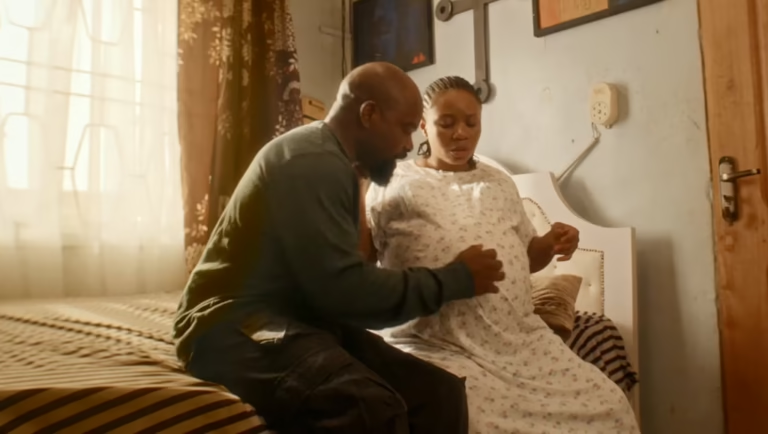
In 2026, Chukwuka Kenechukwu Ndife’s crime thriller Blood Debt gave Patrick Diabuah the most technically demanding lead role of his screen career. As Superintendent Danjuma Okoro, a man holding himself together through the rigour of his work while his marriage quietly unravels, he delivered a performance in which the character’s internal architecture was communicated almost entirely through what was not said. The silences were as legible as the dialogue.
The performance was not a departure. It was the logical outcome of more than two decades of training, of fifty stage productions, of the discipline of a performer who has always understood that the work of acting is not display but excavation.
Beyond Performance
Diabuah’s engagement with the craft extends beyond his own performances. Since March 2017, he has worked as an acting coach, helping professional and emerging performers analyse scripts, develop characters, and deliver authentic performances on film and television sets. His voice work includes the First Bank at 100 audio documentary and the 2018 Access Bank Lagos Marathon Radio Advert, among others. He is also a sculptor and musician, dimensions of his creative life that he has described not as hobbies but as extensions of the same artistic sensibility.
Where the Story Stands
Patrick Diabuah has been building this career since 1998. He has done it largely without the commercial machinery that creates household names in Nollywood. He has no franchise, no single breakout role that became a cultural moment, no viral presence. What he has instead is a body of work that holds up to close inspection across every medium he has worked in, and a reputation among directors and producers for being the kind of performer who shows up prepared and delivers precisely what the role requires.
His career is not over. It is, if Blood Debt is any indication, in one of its most productive phases. But what the story so far reveals is a performer who understood from very early that the work was the thing, and who has spent more than two decades proving it quietly, consistently, and without much fuss.
The stage found him first. It has never really let him go.