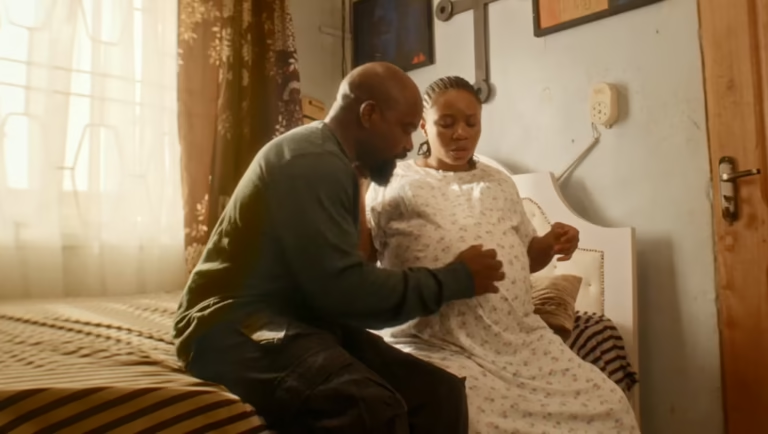
Call of My Life, directed by Dammy Twitch, written and led by Uzoamaka Power, and produced by Blessing Uzzi under Bluhouse Studios, is the rare film that arrives knowing exactly what it wants to feel like.
Nollywood’s romantic comedies have never lacked comedy. What they’ve been missing, for longer than the genre deserves, is whimsy. The specific texture of a story that sees the world through the eyes of someone who believes, fully and without embarrassment, that love is worth the spectacle.
Call of My Life follows Soluchi, a call centre agent and hopeless romantic still healing from the emotional bruising of a past relationship, whose life tilts toward possibility when a phone call connects her voice to Eli, a man so taken by it that he goes looking. It is warm, deliberately fantastical, and unabashedly corny in the best possible way. It is also, at its heart, a love letter from a writer who may have been writing about herself all along.
Call of My Life
Directed by: Dammy Twitch
Produced by: Blessing Uzzi
Genre: Romace, Drama
Released on: May 15, 2026 (Cinemas)
Language: English
A Woman Who Refuses to Dim
The emotional grammar of this film is built around a very specific kind of wound. Soluchi is not heartbroken in the conventional sense. She has been told that she is too much. Too romantic, too expressive, too loud in love. Her ex, Kalu, is not a villain, and the film earns real credit for not writing him as one. He is the kind of man many Nigerians recognise immediately: present, dependable, focused on providing, and entirely unprepared for the magnitude of what Soluchi offers.
Their love language mismatch runs through every scene they share. She writes paragraphs, he replies in single words. She shows up at his workplace with cake, he calls his mother to say she is too childish. Nothing he does is cruel in a simple way. He simply cannot hold what she brings. And when he tells her, in so many words, that she loves too much, the request to give him space to miss her doesn’t just end a relationship. It installs a doubt.
That doubt is what Call of My Life is really about. Soluchi carries Kalu’s voice into her next chapter, dimming her texts, second-guessing her instincts, shrinking the version of herself that existed before he arrived. The moment Eli says “be an adult” triggers something disproportionate in her, and the film handles it correctly. It’s not overreaction. It’s residue. Someone has been in her ear.
Even language carries the weight of this dynamic. Soluchi speaks more Igbo around Kalu, as if performing a more contained version of herself, and moves more freely into English with Eli. It is a quiet but precise observation about code-switching in intimacy, about how we adapt our very voice to fit the expectations of people we are trying to be loved by. The theme that emerges from all of this, don’t dim your love for the wrong person, is stated not through dialogue but through every structural choice the film makes.
The family that surrounds Soluchi deepens it further. When was the last time a Nigerian film gave us a mother so genuinely tender with her daughter, a father so soft and present? Those scenes are brief but they explain everything. You understand exactly why Soluchi is the way she is. She comes from a home that sees people fully.
Where the story falters is in Eli. Soluchi receives emotional architecture: a wound, a history, a process of healing, and a clear internal arc. Eli receives a personality. He is attentive, intentional, charming, willing to move mountains, but the screenplay doesn’t give him much beyond that. His geography is never resolved: introduced at a train station, later mentioned as having come from Ghana, later still shown travelling back to Ghana to visit his mother. The film never explains what any of this means about his daily life. He arrives when the story needs him and recedes when it doesn’t. Soluchi earns her love story. Eli is mostly the prize.
The result is that the film’s confessions, some of which are achingly well-written, arrive before the relationship has fully earned them. The airport monologue is perfectly corny in the register this film is working in, corny in the way that makes you smile and raise an eyebrow simultaneously, which is exactly right for the genre. But there are other moments where the words are reaching for a depth of feeling the scenes haven’t yet built. The film wants to be a happily ever after. It should have trusted itself to be a beautiful beginning.
Where the Glass Slipper Starts to Crack
Soluchi at a shop, deliberating between chamomile and green tea for her boyfriend, already telling you everything you need to know about who she is and who he isn’t. The first act earns its ground efficiently. The ending delivers too, the airport sequence carrying emotional payoff the film has been building toward, even if its internal logic doesn’t survive scrutiny.
Anyone who has navigated a Nigerian airport knows the boarding gate is not accessible without a boarding pass, but the genre earns a degree of suspended disbelief, and the film mostly holds that suspension through sheer charm.
The screenplay’s broader problem is its relationship with cause and effect. A fairytale is permitted its coincidences. Two characters meeting at the same restaurant, a mutual friend who turns out to be a coworker, Eli calling the call centre repeatedly just to hear one voice; these are the genre’s features, not its failures. But the film repeatedly skips the connective tissue between plot beats. Sol is fired for oversharing with a customer and then somehow returns and is promoted to supervisor with no visible professional growth and no institutional logic to explain the shift.
The supervisor framed as her obstacle never quite earns the antagonism the film assigns him. A hearing-impaired colleague is introduced in circumstances that are never clearly framed as discrimination or mere professional incapacity. These are not romantic coincidences. They are structural shortcuts, and they accumulate into a credibility problem.
The issue is tonal inconsistency. A film that commits fully to fantasy can ask you to believe almost anything. But Call of My Life moves between realism and fairytale without signalling the transitions clearly, which means audiences begin applying real-world logic to scenes built only to carry emotional weight. The world starts asking questions the screenplay hasn’t prepared to answer.
The Company Worth Its Warmth
Uzoamaka Power doesn’t play Soluchi so much as she becomes her, which is a meaningful distinction. She wrote this screenplay and she leads this film, and the closeness between the two roles is visible in every scene. There is no gap between character and performer here. She carries the film’s whimsy without ever letting it tip into self-parody, and in the quieter moments, particularly when Soluchi is trying not to be herself, the restraint is as impressive as the expressiveness. To write a character this specific and then inhabit her this completely is the work of someone with an unusually clear sense of her own creative instincts.
Nkem Owoh and Patience Ozokwor as Soluchi’s parents are the film’s warmest surprise. Owoh moves through the role with the easy authority of someone who has spent decades learning when to be funny and when to simply be present. He is lightness when the film needs air and weight when it needs grounding. Ozokwor matches him at every turn. Their chemistry as a long-married couple is so natural and specific that every scene they share feels like a stolen glimpse into a real home. Together, they are a reminder of why both remain the standard in this industry.
Zubby Michael does something harder than it looks with Kalu. He plays a man who isn’t wrong exactly, only incompatible, and he finds the human core of that without erasing the damage Kalu causes. Call of My Life occasionally pushes too hard against him: a scene where he calls his mother to describe Soluchi as too childish is designed to make audiences dislike rather than simply understand him, and that feels like a miss in a film otherwise mature about this dynamic. Michael navigates it with enough nuance to keep the character from collapsing into a caricature, but the writing works against him in those moments.
Andrew Bunting is charming as Eli and carries the role with genuine warmth. The limitations belong to the writing more than the performance. Eli’s geographic ambiguity, his vague daily existence, the train station setup that promises something and never delivers it; these are problems no amount of charm can paper over.
Justin Ugonna, in his debut screen performance as Ezekiel, is a genuine find. There is no visible effort, no overacting, no seams showing. He simply fits the role the way someone fits a shirt made for them. Beverly Osu as Zimuzo is lively and present, even if the film doesn’t give her the room she could fill. Samuel Ajibola, known as Brother Shaggy, delivers a pleasant surprise in what could easily have been a throwaway role.
The Frame That Loves What It Sees
Dammy Twitch makes is feature film debut from the Afrobeats music video world, and it shows in the best possible way. The cinematography, handled by Muhammad Atta Ahmed, has the visual consciousness of someone accustomed to making every frame carry meaning. The colour palette leans into Soluchi’s sensibility, warm and saturated and slightly heightened, as though the world is being seen through the eyes of someone who still believes in enchantment.
Every location, every room, every space feels emotionally curated rather than merely set-dressed. Anita Ashiru’s production design works in perfect conversation with this, building a world that feels attainable for a middle-class Nigerian audience without feeling ordinary. It doesn’t look aspirational. It looks inhabited.
What Twitch gets most right is restraint. This is not a film drunk on its own production value. There are no gratuitous Lekki apartments, no luxury-car establishing shots, no aesthetic flexing for its own sake. The environments serve the characters, which sounds like a low bar until you see how regularly Nollywood films fail to clear it. He understood the assignment, maintained that understanding across every department, and delivered a film where all the craft is pulling in the same direction.
The sound design is one of the Call of My Life‘s quietest achievements. A park scene comes alive with ambient chatter and the sounds of people living around the edges of the frame, the kind of environmental texture that places you physically inside a moment rather than simply in front of it. Cobhams Asuquo’s score wraps the story in exactly the right emotional register: romantic without being saccharine, intimate without being overwrought.
The Johnny Drille sequence arrives in the film’s final stretch and sits in slightly ambiguous territory. It is consistent with who Eli is supposed to be, a man willing to go to extraordinary lengths to make his love visible, and it fits the film’s spirit completely. But it carries the faint outline of a brand collaboration, and the screenplay hadn’t quite earned the sequence before it landed. It sits on the enjoyable side of unnecessary. Most audiences will go with it warmly, and they won’t be wrong to.
Final Thoughts
There is a question worth sitting with after Call of My Life: why has it taken this long? Nollywood’s romantic comedies have existed for decades. They have delivered comedy in abundance and tenderness in smaller doses, but the particular quality this film carries, that Wednesday-weird, hyperpop, fully committed whimsy, has been almost entirely absent from the genre’s recent output.
Earlier romcoms tried for a kind of aspirational slickness, placing characters in beautiful apartments and giving them articulate problems. Call of My Life tries for something more specific and more honest: a character who is strange in the way that real people are strange, who loves in a way that embarrasses her, whose life looks like something you might actually recognise.
The film’s greatest achievement is not its romance. It is everything surrounding it. The family. The friendship. The production design. The way a writer has poured herself into the work so completely that the film feels not just made but lived in. Uzoamaka Power hasn’t made a film about love. She has made a film about a woman, and the love story is what happens to that woman while the film is paying attention to other things.
The limitation is that the romance at the centre, the thing the film is nominally about, never quite earns the emotional declarations it arrives at. The confessions are written for a relationship that has been lived in for years, not the one we’ve been shown. You can root for Soluchi and Eli. You just can’t quite believe them yet.
A braver ending, one that trusted this as the beginning of something rather than the resolution of everything, would have been more honest to what Call of My Life actually built. What remains after the credits is genuine warmth, the feeling of having spent time with people who gave everything to the craft. And in this genre, that counts for more than it should have to.
Verdict
Go and watch it, especially if you’ve ever been told your love is too much. This film was written for you, and it knows what it is doing.
Call of My Life suits viewers who need their romantic comedies to also be emotionally intelligent, it earns that credibility in the margins even when the central romance falls slightly short of its own ambitions. It is an honest film, and that is rarer.
Rating: 3.35/5