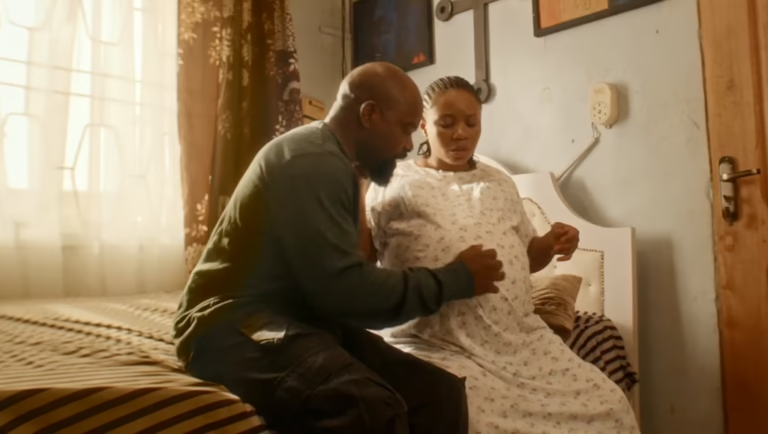
A happy ending, in the language of the massage industry, is a service that extends beyond its stated purpose. In the language of storytelling, it is the resolution audiences are trained to want: difficulty navigated, goodness rewarded, the right people walking away into something better than where they started. Dika Ofoma’s thirty-five-minute film, the final entry in Zikoko Life’s second outing, holds both meanings in tension from its title to its last scene, and the generosity it finds in that tension is what makes it the strongest of the three films the anthology has produced this year.
Tatiana, played by Ifeoma Obinwa, arrives in Lagos from the southeast with a specific skill and a specific ambition. She is a trained masseuse who has come for better opportunities, and what she finds at the spa her friend Ginika has arranged for her is a particular kind of Lagos reality: a business that presents one thing on its signage and quietly offers another through arrangement. Three days into the job, a senator becomes a regular client. And then the root of all evil sets in.
A Happy Ending
Directed by: Dika Ofoma
Written by: Dika Ofoma
Genre: Drama
Language: English, Igbo
A Woman Who Made a Choice
What makes this A Happy Ending’s approach to its subject significant is the decision Dika Ofoma made before a single scene was shot. He refused to write Tatiana as a victim. Tatiana is an adult who looks at her options and chooses the one that keeps her ambitions alive. The choice has costs. The film is honest about every one of them. But she enters the situation with her eyes open, and the film treats that as the truth of the matter rather than a moral failing to be corrected.
This is a more radical decision than it might appear. It means the film cannot reach for the traditional Nigerian storytelling comfort of the punished woman, the sinner who suffers so that the audience can be reassured that the moral order holds. Three actresses reportedly turned down the role because the character was not written with enough suffering to justify her choices in their view. What that tells us about the society in which this film exists is arguably as interesting as the film itself. The willingness to follow a woman who made a difficult, imperfect, economically rational choice, and to let her find her own way to something better, is a meaningful creative position.
Ginika, played by Ruby P. Okezie, is Tatiana’s friend and her entry point into this world. Their friendship is the film’s emotional constant. It bends, strains, and at one point very nearly breaks, but it holds. Madam Ngozi, played by Anne Njemanze, manages the spa with the pragmatic authority of someone who has seen this story from both sides. The film’s most humanising choice, and its most honest, is the decision not to write her as the villain. She is an enabler of an exploitative arrangement, but she is also a woman who has navigated the same city and the same pressures by different means, and her passing of contraception to Tatiana before the arrangement deepens reads as genuine, if limited, care. The film understands that most people doing damage are not doing it with malice. They are doing it with rationalisation, which is a more uncomfortable truth.
The Familiar Path, Taken Differently
The plot moves through territory that Nollywood has visited before: the young woman from the southeast, the powerful older man, the corrupting influence of money, the friend drawn in against her better judgment. What changes is the destination.
The film does not dramatise what ensues as violence. It dramatises it as power, which is both more accurate and more disturbing. The senator does not need to threaten or coerce because the economic architecture of the arrangement has already done that work. Tatiana’s agency was intact when she entered. It narrowed incrementally as the money deepened the dependency. The film traces that narrowing with care, showing how each convenience functioned as a gift and as a leash simultaneously.
Ginika and Tatiana’s decision is the film’s central act of reclamation. The ending is not triumphant in the way of a moral parable. It is quiet and warm and aware of what it cost to get there. A happy ending, the film suggests, is not the absence of difficulty. It is arriving somewhere of your own making.
Performances That Know the Territory
Ifeoma Obinwa’s Igbo is the first thing that distinguishes her in the role. In a film where the language is a cultural statement as much as a narrative choice, the authenticity of her speech communicates that Tatiana belongs to a specific place and carries that place with her. Obinwa plays the character’s naivety not as stupidity but as inexperience with a particular kind of city sophistication. Tatiana never fully adapts to the world she enters because she was never entirely comfortable in it. Her wide-eyed quality is not vacuousness. It is the look of someone who is enjoying what the money makes possible while staying slightly outside the thing producing it.
Ruby P. Okezie as Ginika has the film’s most interesting character arc precisely because Ginika is the more pragmatic of the two. Her eventual choice is the film’s most morally complex beat. The ambiguity of that moment is genuine: did she stay out of fear, calculation, or a decision she was making for herself? The film does not answer cleanly, and Okezie does not play it clean. That unresolved quality is the right choice for a character who is making her own compromises on her own terms.
Anne Njemanze as Madam Ngozi gives the film’s most textured supporting performance. The character manages a harmful arrangement while believing she is managing it responsibly. That self-deception is human and recognisable, and Njemanze plays it without irony or condescension.
The Music and the Memory of a Different Nollywood
The choice to use Oriental Brothers and Dwin the Stoic in the film’s musical texture is specific and deliberate. This is music that carries the sound of an older Igbo cultural world, and its presence in a film about young women navigating contemporary Lagos creates a productive friction. It suggests continuity, that these women are part of a long lineage of women who have navigated difficult circumstances with what they had, while simultaneously refusing to moralise that lineage in the way older Nollywood often did.
The cinematography and pacing are the film’s most consistent technical achievements. Dika Ofoma knows where to cut and where to hold, and the editing rhythm contributes to the film’s emotional intelligence in ways that less disciplined short filmmaking would have forfeited. There is a visual warmth to the film, particularly in the friendship scenes, that does not romanticise the circumstances but refuses to render them only as grim. The Igbo language running through the film is both a cultural anchor and an aesthetic pleasure, giving the story a specificity that generic casting in generic Lagos English would have eliminated.
Final Thoughts
Watching all three films in Zikoko Life’s second outing together reveals something about what the anthology has been attempting. Siraam opened with a woman navigating what happens to the self after a man who was never hers moves on. Before We Fall Asleep followed a couple whose assumed arrangements became visible and unstable when one source of income disappeared. A Happy Ending closes the series with a woman who chooses a path fully knowing where it leads and finds, eventually, a different way through.
All three films are about the same thing, in the end: what it costs Nigerian women to exist inside economic and emotional systems that were not designed with their wellbeing as the primary concern. And what it looks like when they find their way through those systems on their own terms. The consistency of care, in the writing, in the visual language, and in the choice not to moralize what it depicts, marks Zikoko Life as one of the more meaningful short film spaces currently operating in Nigerian storytelling.
A Happy Ending is the best of the three. It is also, by its own admission and by the logic of its own title, the most hopeful.
Verdict
Watch this, ideally after watching Siraam and Before We Fall Asleep, though it stands on its own. It is thirty-five minutes of filmmaking that takes its characters seriously, uses the Igbo language as both culture and pleasure, and earns its ending without sentimentality. Dika Ofoma closes the series with the most mature and formally assured film of the outing. It is a complete film: beginning, middle, and a happy ending that actually feels like one.